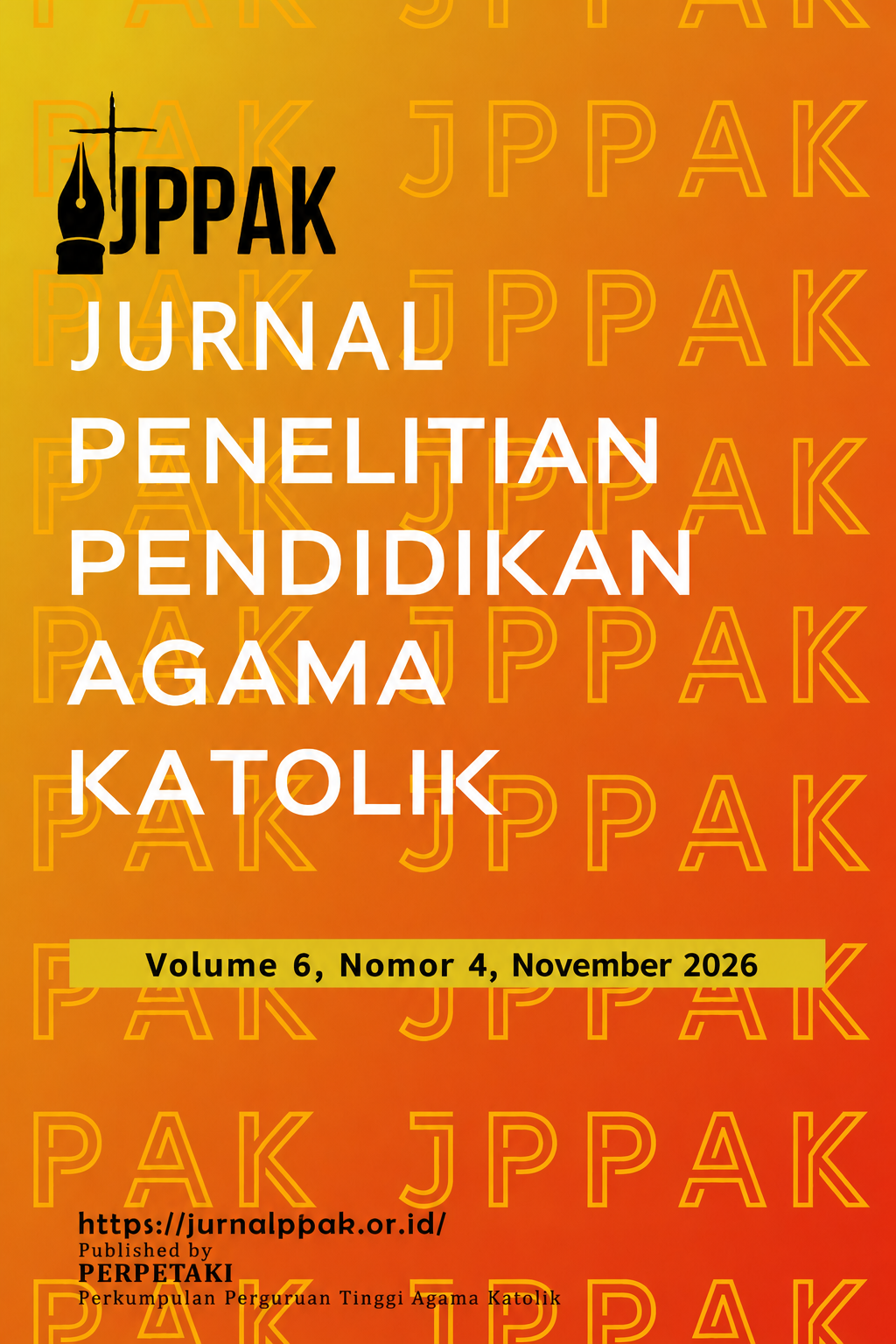
Makna Sakramen Tobat dalam Kehidupan Remaja Katolik: Studi Kuantitatif Pelajar Katolik di SMPN 8 Yogyakarta
DOI:
https://doi.org/10.52110/jppak.v6i4.810Keywords:
Sakramen Tobat, Remaja Katolik, Rekonsiliasi, Sekolah Negeri, Katekese RemajaAbstract
Masa remaja merupakan fase transisi krusial dalam pembentukan kemandirian moral dan suara hati, namun remaja Katolik di sekolah negeri sering kali menghadapi keterbatasan pembinaan rohani serta pergulatan batin berupa rasa malu dan takut saat hendak menerima Sakramen Tobat. Penelitian kuantitatif ini bertujuan untuk memetakan secara mendalam bagaimana para pelajar Katolik di SMPN 8 Yogyakarta memaknai dan menghayati Sakramen Tobat dalam kehidupan sehari-hari. Kajian ini mengeksplorasi lima hal utama, meliputi pemahaman teologis, pengalaman personal penerimaan sakramen, rekonsiliasi dengan Allah, rekonsiliasi dengan sesama, serta penghayatan moral praktis. Hasil penelitian menunjukkan bahwa mayoritas remaja memiliki pemahaman teologis yang matang mengenai esensi pertobatan dan rekonsiliasi. Secara afektif dan spiritual, keberanian mengaku dosa di hadapan imam menghadirkan kedamaian batin, kelegaan, serta motivasi untuk memulai lembaran hidup baru. Sakramen Tobat terbukti memperkokoh relasi remaja dengan Allah dan menggerakkan aksi nyata rekonsiliasi melalui inisiatif meminta maaf serta mengampuni sesama. Meskipun menghadapi tantangan berupa kecenderungan kembali jatuh pada kesalahan yang sama, para remaja sepakat bahwa keabsahan makna pertobatan teruji dalam perjuangan konsisten memperbaiki sikap hidup sehari-hari. Implikasi dari studi ini menekankan pentingnya pembaruan pendekatan katekese dan pendampingan pastoral yang lebih ramah, empatik, serta relevan bagi remaja di sekolah negeri, agar Sakramen Tobat dihayati bukan sebagai pengadilan moral yang menakutkan, melainkan sebagai perjumpaan kasih Allah yang menyembuhkan dan membina karakter beriman.
Downloads
##submission.downloads##
Submitted
Accepted
Published
How to Cite
Issue
Section
License
Copyright (c) 2026 Rudi Lesmana, Andreas Pebrianto, Yohanes Subali

This work is licensed under a Creative Commons Attribution-ShareAlike 4.0 International License.
Copyright Notice and Permissions
Jurnal Penelitian Pendidikan Agama Katolik offers immediate open access to all its content on the principle to make researches freely available to the public, especially to the scholars, to support greater global exchanges of knowledge. This journal encourages all scholarly authors to allow their research openly available, free access and without time restrictions.
All articles published Open Access will be immediately and permanently free for everyone to read and download. Under the CC BY-SA 4.0 license, authors retain ownership of the copyright for their article, however authors grant others permission to use the content of publications in Jurnal Penelitian Pendidikan Agama Katolik (JPPAK) in whole or in part provided that the original work is properly cited. Users (redistributors) of Jurnal Penelitian Pendidikan Agama Katolik (JPPAK) are required to cite the original source by including at least: the full title of the article, the author's or authors' full name(s), JPPAK as the initial source of publication, year of publication and volume number using a propriate citing method.
Copyright encompasses exclusive rights to reproduce and deliver the article in all form and media, including reprints, photographs, microfilms and any other similar reproductions, as well as translations. The reproduction of any part of this journal, its storage in databases and its transmission by any form or media, such as electronic, electrostatic and mechanical copies, photocopies, recordings, magnetic media is prohibited without consent of Jurnal Penelitian Pendidikan Agama Katolik (JPPAK).
Jurnal Penelitian Pendidikan Agama Katolik (JPPAK) is licensed under a Creative Commons Attribution Share-Alike 4.0 International. (CC BY-SA 4.0)
Authors who publish with Jurnal Penelitian Pendidikan Agama Katolik (JPPAK) agree to the following terms:
- Authors retain copyright and grant the journal right of first publication with the work simultaneously licensed under a Creative Commons Attribution Share-Alike 4.0 International (CC BY-SA 4.0) license that allows others to share the work with an acknowledgement of the work's authorship and initial publication in this journal.
- Authors are able to enter into separate, additional contractual arrangements for the non-exclusive distribution of the journal's published version of the work (e.g., post it to an institutional repository or publish it in a book), with an acknowledgement of its initial publication in this journal.
- Authors are permitted and encouraged to post their work online (e.g., in institutional repositories or on their website) after the publication on JPPAK, as long as it not published on other OJS for it will be treated as plagiarism by plagiarism checker apps. It can lead to productive exchanges, as well as earlier and greater citation of published work (See The Effect of Open Access).